

Transform Your ERP with Smarter, Data-Driven Order Policies
Reduce stockouts, cut excess inventory, and bring predictability back to your supply chain with a practical framework for selecting the right Order Policy for every item.
Build a Planning Strategy Your ERP Can Actually Trust
This playbook breaks down the most effective replenishment methods—Periodic Review, Order Quantity Systems, Reorder Point (Min/Max), and C-Class strategies—while showing how to apply ABC and XYZ segmentation to automate smarter order decisions.
Ready to streamline your ERP planning?
Download the full playbook and get a step-by-step framework for aligning replenishment strategy with item value, demand variability, and operational constraints.
Your ERP Is Only as Effective as the Strategy Behind It
Most teams rely on outdated order policies—values set years ago, copied from one item to another, or patched together after stockouts. The result? Unpredictable planning, inflated inventory, and constant firefighting.
This guide breaks down how to fix it with a clean, structured approach rooted in item segmentation and modern replenishment logic.
What You’ll Learn
The Hidden Cost of Bad Order Policies
When your order policies don’t reflect today’s reality, your entire planning process starts breaking down.
Most ERPs are running on stale replenishment rules—order quantities set years ago, reorder point (min/max) levels copied from another item, safety stock that’s running on outdated assumptions.
Meanwhile, the business keeps moving: demand patterns shift, supplier lead times creep, costs change, and volatility increases.
But the planning logic stays the same.
The result is predictable:
- Inventory swings between too much and not enough
- Buyers scramble to expedite materials that should’ve been forecasted
- Planners override the system because they no longer trust it
- Production gets disrupted by shortages of low-value parts
- Working capital disappears into excess stock that no one meant to buy
Bad order policies don’t show up as a single point of failure—they create a constant drag on the business.
They inflate inventory, erode service levels, and force your best people into endless manual correction work.
The cost isn’t just operational.
It’s strategic.
Because no planning team can move the business forward when they’re busy fixing the same avoidable problems every week.
The Playbook for Smarter, More Predictable Replenishment
When your replenishment logic matches how your business actually behaves, planning becomes faster, cleaner, and dramatically more accurate.
Most teams rely on a single replenishment rule for every part—simply because it’s the easiest thing to maintain.
But not every item behaves the same.
High-velocity SKUs don’t need the same control as unpredictable components.
Low-value parts don’t deserve the same attention as critical A-items. And traceability-heavy materials can’t be planned using the same logic as bulk fasteners.
This playbook breaks down the core replenishment models that every supply chain team should understand, and more importantly, shows where each model fits:
- Periodic Review Systems
- Order Quantity Systems
- Reorder Point (Min/Max)
- C-Class Strategies
Each model includes a high-level view of how it works, why it works, and how to avoid common misapplications—giving you the clarity needed to choose the right strategy for each item without adding complexity.
This isn’t about learning more theory.
It’s about giving your team a practical, repeatable way to modernize replenishment logic across thousands of SKUs—without overwhelming your planning team.
When to Use Each Order Policy
Matching the right policy to the right item eliminates guesswork and reduces noise in your planning system.
One of the biggest hidden failures in supply chain planning is treating every item the same.
Most ERPs default to a single replenishment method across thousands of parts—not because it’s right, but because it’s easier than maintaining the nuance each item truly requires.
The result is a patchwork of mismatched order rules:
- high-velocity items planned with too much precision
- slow movers run on overcomplicated logic
- critical components controlled by outdated parameters.
This section of the guide shows how to break that cycle by matching each planning method to the conditions where it performs best.
Below is a high-level preview of how each model fits:
Use Periodic Review Cycles When Cadence Outweighs Complexity
Use Order Quantity Systems When Cost, Lead Time & Precision Matter
Examples covered in the playbook:
- Discrete (Lot-for-Lot)
- Period Order Systems
- Order Modifiers
Use Reorder Point (Min/Max) When Demand Is Steady and Value Is Low-to-Moderate
Use C-Class Strategies to Remove Low-Value Parts from Daily Planning
Choose the right approach for each item class, and your planning system becomes dramatically more accurate—without adding unnecessary complexity.
This playbook helps you replace guesswork with a practical framework that scales.
Why One-Size-Fits-All Planning Breaks Your Inventory Strategy
When every item is treated the same, planners drown in noise and inventory drifts out of control.
Most supply chains manage thousands of parts, yet rely on a single level of control for all of them.
High-value components get the same rules as low-value fasteners.
Stable, predictable items are planned the same way as volatile, irregular ones.
And without segmentation, planners are forced to make judgment calls the system should’ve made automatically.
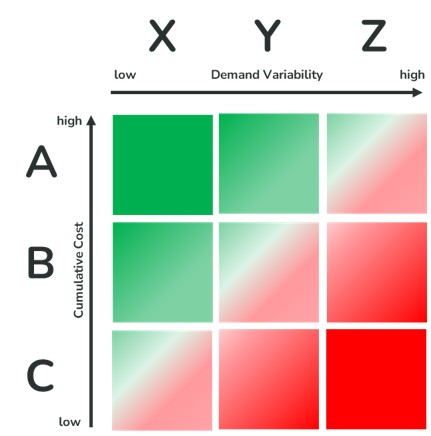
This playbook breaks down how value and variability—two simple, proven principles—create the foundation for smarter replenishment:
ABC Classification: Focus on what drives cost.
A-items need precision and tighter oversight.
B-items require balanced control.
C-items should be automated to free planners from unnecessary work.XYZ Variability Analysis: Focus on how demand behaves.
X-items are stable and predictable.
Y-items fluctuate, often seasonally.
Z-items are erratic and need buffers, not forecasts.
But the real power comes when the two are combined.
Using ABC and XYZ together creates a 9-block segmentation model that clarifies exactly how each item should be planned.
It transforms replenishment from a guessing game into a structured, repeatable decision framework:
- High-value, stable demand items → precise, cost-efficient policies
- Mid-value, moderate demand items → periodic or buffer-based approaches
- Low-value, volatile items → automation or strategic safety levers
The result is a planning environment where:
- Planners focus on high-impact items
- Low-value materials manage themselves
- Policies align with real-world behavior
- The system retains control instead of being overridden
This section gives you the blueprint for turning an unstructured set of planning data into a clear, organized strategy—one that scales across thousands of SKUs without adding to planner workload.
A Way to Keep Order Policies Aligned With Reality—Not Guesswork
When your planning rules depend on spreadsheets and tribal knowledge, they fall out of sync with the business—and your ERP stops working the way it should.
Most teams know what an effective planning strategy should look like.
The challenge isn’t understanding the best practices—it’s maintaining them across thousands of items as demand shifts, suppliers change, and operations evolve.
That’s where the process breaks down.
Order policies drift.
Safety stock becomes outdated.
Reorder Point (Min/Max) levels never get reviewed.
ABC and XYZ classifications are set once and never touched again.
Pretty soon, planners are overriding the system because the system no longer reflects reality.
Nvexus changes that by automating the parts of order policy management that no team can realistically keep up with manually.
With Nvexus, the heavy lifting becomes automatic:
- ABC & XYZ classification — always current, never stale
- Economic Order Qty and Period Order calculations — aligned to real demand and costs
- Reorder Point (Min/Max) calculation — tied to consumption and variability
- Safety Stock recommendations — based on real statistical behavior
- Order Policy assignments — guided by strategy, not guesswork
- Exception monitoring & alerts — so planners only fix what truly matters
- Parameter drift detection — catch issues before they undermine ERP
- Role-based planner workflows — ensuring consistency across teams
The guide gives you the strategy.
Nvexus ensures the strategy stays alive—week after week, year after year—no spreadsheets required.
FAQs
What is an Order Policy in an ERP system?
A rule that determines how much and when to order for each item. It drives replenishment logic inside ERP.
How do I know which Order Policy to use?
Use segmentation: high-value items need tighter controls, , and low-value parts can rely on looser controls.
The playbook provides guidance on what exactly is the best solution for each type of part.
When should I use Reorder Point or Min/Max?
Periodic Review sets replenishment frequency.
Order Quantity calculates the most appropriate order size.
Where can I find support?
For lower-value, predictable items where simplicity and availability matter more than precision.
Is Discrete (Lot-for-Lot) only for regulated industries?
No, but it’s best used when traceability, accuracy, and minimal inventory buildup are priorities.
Do ABC and XYZ classifications need to be reviewed often?
Yes—demand patterns and costs change. Most companies refresh classifications monthly or quarterly.
Does Economic Order Quantity (EOQ) really work in modern supply chains?
Yes—as a guideline, not a literal per-SKU instruction. It helps define reasonable order sizes and planning cadence.
Is the 9-block ABC/XYZ strategy too advanced for smaller companies?
Not at all. The matrix simplifies decision-making and reduces manual setup effort across thousands of items.