

Master Your C-Class Planning: Cut Planner Effort While Increasing Availability
C-class parts drive most of your planning workload — but only a fraction of your spend.
Learn how to simplify the chaos, standardize your approach, and build a repeatable strategy using proven best practices from the field.
A Proven Blueprint for Managing Low-Value, High-Volume Parts
The C-Class Planning Strategy Guide walks you step-by-step through the methods, logic, and decision frameworks used by operations teams to reduce fire drills, eliminate shortages, and streamline ERP planning for low-value parts.
This guide gives planners, buyers, and materials leaders the clarity they’ve been missing — and the tools to simplify replenishment at scale.
Download the Guide
Enter your details to unlock the complete C-Class Planning Strategy Guide.
Get immediate access to frameworks, checklists, and examples you can apply today.
Bonus Included With Your Download
When you download the C-Class Planning Strategy Guide, you’ll also get two additional implementation playbooks for free:
- The VMI Implementation Blueprint — setup rules, ERP parameters and transactions, and bin logic.
- The Kanban (Bulk/Supermarket) Operating Playbook — eligibility rules, bin sizing, transactions, and stockroom standards.
These resources go beyond strategy and show you exactly how to implement VMI and Kanban systems on the shop floor and inside your ERP.
No extra steps. Automatically included.
Why C-Class Planning Fails — and How to Fix It
C-Class items overwhelm planners for one simple reason: there are thousands of them. Each one is low value on its own, but together they create an endless stream of exceptions, parameter fixes, and last-minute scrambling.
Most teams fight this volume manually — and lose. ERP signals drift, bins run empty, and planners get pulled into work that delivers almost no financial impact.
This guide breaks the cycle. It shows you how to turn a messy C-Class portfolio into a structured, rules-based system where availability goes up, planner effort goes down, and low-value parts stop dominating your day.
What You’ll Learn
Why C-Class Parts Drain More Time Than Value
Most organizations manage low-value parts with high-effort processes — and pay the price in planner burnout and avoidable shortages.
C-Class items represent the largest portion of your parts, but individually contribute almost nothing to inventory value. The problem is volume: thousands of small parts, each with different demand and usage patterns, lead times, and ERP setups.
One misaligned parameter or empty bin doesn’t just cause noise — it cascades into shortages, expediting, and hours of planner rework.
This guide shows you how to cut through the clutter. You’ll learn how to segment C-Class parts by value and volatility, apply the right replenishment method to each category, and rebuild a planning foundation that’s easier to maintain — and far harder to break.
When Everything Is Manual, Nothing Is Under Control
Planners end up reacting to low-value parts instead of managing the material that actually matters.
Most C-class programs break down because they’re built on manual updates and inconsistent rules. As parameters drift, ERP signals fail and planners get trapped in a cycle of firefighting instead of planning.
This guide shows you how to stabilize your C-class strategy with clean segmentation, standardized replenishment methods, and a maintenance rhythm that keeps everything aligned as demand shifts.
Five Proven Ways to Stabilize Low-Value Parts
Not all C-Class items deserve the same planning method. Choosing the wrong one leads to shortages, excess, or both.
Most teams struggle with C-class planning because they try to manage every low-value part the same way. But each part behaves differently — some move quickly, some move slowly, and some are unpredictable.
When everything follows one blanket rule, availability drops and planner workload spikes.
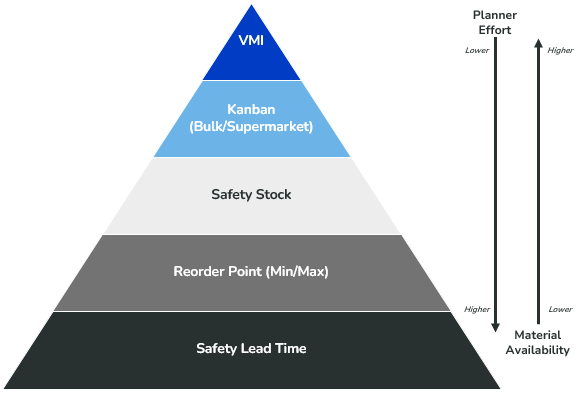
This guide breaks down the five proven C-class methods that actually work in the real world:
- Vendor Managed Inventory (VMI)
- Kanban (Bulk/Supermarket)
- Reorder Point (Min/Max)
- Safety Stock
- Safety Lead Time
You’ll learn when each approach makes sense, what it takes to run it well, and how to match the right method to each part using simple ABC and XYZ analysis.
With the right strategy assigned to every part, you create a true Plan for Every Part (PFEP) — a planning foundation that increases material availability, reduces effort, and keeps your ERP running clean and consistent.
One Framework to Assign the Right Strategy to Every Part
Stop guessing. Start assigning C-Class strategies based on value, volatility, and risk.
Picking the right planning method for each C-class part doesn’t have to be a guessing game.
The decision tree in this guide gives you a clear, step-by-step way to sort every item by value, demand, size, and risk.
By following the framework, you’ll know exactly when to use VMI, Kanban, Min/Max, Safety Stock, or Safety Lead Time — and how each choice connects back to your ERP settings.
It’s simple to understand, easy to apply, and built to help you keep material availability high with less planner effort.
Data-Driven C-Class Planning — Without the Manual Work
This guide teaches the strategy. Nvexus makes it operational.
Most teams understand how C-Class planning should work.
The real challenge isn’t the strategy — it’s keeping that strategy accurate when you’re managing hundreds or thousands of low-value parts that constantly shift in demand, lead time, and risk.
That’s where C-Class planning usually breaks down.
ABC and XYZ classifications get outdated.
Safety Stock numbers drift.
Reorder Point (Min/Max) values don’t match real usage anymore.
Kanban bins get sized once and never reviewed.
And before long, planners are working around the ERP because the system no longer reflects what’s happening on the shop floor.
Nvexus changes that by automating the parts of C-Class planning that no team can realistically keep up with manually.
With Nvexus, the heavy lifting becomes automatic:
- ABC & XYZ classification — always up to date
- Strategy recommendations — tied to value and volatility
- Safety Stock recommendations— based on real statistical demand and usage
- Reorder Point (Min/Max) calculations — aligned to consumption and lead time
- Order Policy assignments — guided by strategy, not guesswork
- Parameter drift detection — catch issues before they cause shortages
- Clean ERP alignment — strategy and setup stay in sync
- Exception alerts — so planners only fix what actually matters
The guide gives you the strategy.
Nvexus keeps that strategy alive — accurate, consistent, and always up to date — without spreadsheets, guesswork, or endless manual work.
FAQs
What are C-class parts?
Low-value items that make up the majority of your parts but only a small portion of total spend.
Why do C-class items require a different planning approach?
Manual oversight of thousands of C-class parts leads to inconsistent ERP parameters, noisy signals, and planner overload. These items must be managed with strategies that minimize intervention and maximize material availability.
Effective C-class planning is about automation, standardization, and availability — not micromanagement.
How do I know which replenishment method to use?
Use a combination of ABC (value) and XYZ (volatility) to assign VMI, Kanban, Safety Stock, Min/Max, or Safety Lead Time.
How often should C-class strategies be reviewed?
Quarterly at minimum. Demand, volatility, and supplier performance change frequently.
Why not use a single strategy for all C-class items?
Because each method has different strengths. Applying one approach across all parts leads to excess inventory or shortages.
Does the guide cover ERP setup?
Yes — it explains how to align replenishment strategies with ERP parameters so planning rules match physical execution.
How does Nvexus support C-class planning?
Nvexus auto-classifies parts, recommends the right strategy, calculates parameters, flags exceptions, and tracks exceptions.
Is this guide relevant if we already use Kanban or VMI?
Yes — the guide includes criteria to validate whether you’re using the right strategy and where improvements can be made.