

Stop Supply Chain Firefighting — Start Planning With Confidence
Get the free Master Data Management Guide used by modern operations teams to improve Cost, Cash, and Service — by fixing the root cause of planning chaos.
A smarter way to plan. A cleaner way to scale.
This guide breaks down the hidden drivers behind operational chaos — and the simple Master Data Management (MDM) discipline that separates top-performing supply chains from the rest.
You’ll learn how to:
- Diagnose the root causes behind shortages, expediting, and schedule volatility
- Turn messy ERP data into a reliable planning engine
- Build a MDM cycle that catches issues before they become fires
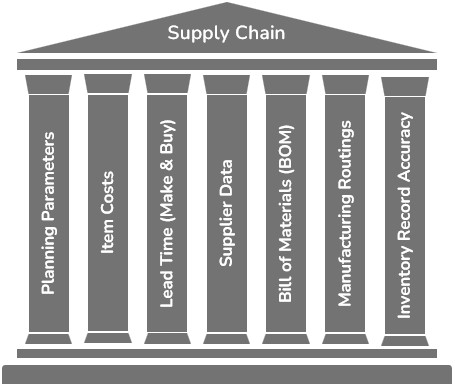
- Strengthen the 7 Pillars of Master Data that power reliable execution
- Unlock measurable improvements in Cost, Cash & Service
This isn’t theory — it’s a practical, modern playbook built for real planning teams.
Download the Guide
Master Data: The Hidden Driver of Operational Excellence
Every supply chain relies on planning data to make confident decisions. When that data is wrong — even by a little — planning grinds to a halt, shortages appear out of nowhere, and teams fall back to spreadsheets.
This guide shows you how to fix the root problem, build repeatable data governance, and turn your planning system into an engine for scale — not stress.
What You’ll Learn
Why Bad Data Breaks Good Supply Chains
When your planning data is wrong, nothing in the business runs the way it should.
Most teams think they have execution problems.
In reality—they have data problems pretending to be execution issues.
Bad Master Data causes a chain reaction of operational pain:
- Inventory shows “available,” yet production can’t start
- Planners spend all day reacting, not planning
- Every late order turns into an expediting bill
- Schedules constantly reshuffle with no clear root cause
- Margin numbers fluctuate without explanation
- Teams lose faith in the system and switch to Excel
- Audit exposure increases because basic data can’t be trusted
But underneath all of this is a deeper issue most teams don’t talk about:
Master Data doesn’t fail in isolation—it fails because no one truly owns it.
- Planning owns some fields
- Supply Chain/Procurement owns others
- Engineering owns BOMs
- Operations owns routings
- Finance owns costs
- IT owns the system
When accuracy depends on five different functions—and nobody has visibility into who updated what—accountability breaks down, and bad data quietly spreads until the entire planning process collapses
These failures aren’t random.
They’re predictable.
And they’re fixable—with the right system in place.
This guide walks you through exactly why these failures happen and the hidden mechanisms behind them.
Why Fixing Master Data Unlocks Growth
Clean, accurate data doesn’t just reduce chaos—it accelerates the entire business.
Once your data stops fighting you, everything downstream gets easier:
- On-time delivery becomes the norm—not the miracle
- Planners manage more work with less stress
- Shortages shrink even as inventory decreases
- Supplier conversations become proactive, not confrontational
- Schedules stabilize and stay intact
- Leaders gain confidence in the numbers they review
Reliable data isn’t a technical upgrade.
It’s a competitive advantage—and often the fastest path to improving performance across Cost, Cash, and Service.
This guide explains why strong Master Data creates outsized business results and how to build the foundation that enables them.
What Happens When Master Data Works
Accurate data strengthens the financial engine of the entire company.
Organizations that fix their Master Data see improvements across all three executive priorities:
Cost → Less expediting, fewer surprises, and higher planner productivity
Cash → Lower inventory without increasing risk
Service → Better promise dates, clearer priorities, and fewer shortages
Good data makes planning scalable.
Great data makes the whole business more profitable.
Inside the guide, you’ll see how these performance gains show up—and why they stick.
The Modern Playbook for Fixing Master Data
Most companies try to clean their data once—and then wonder why the problems return.
High-performing teams use a simple, repeatable rhythm that:
- Defines what “good data” really means
- Surfaces the issues that cause downstream failures
- Prioritizes the highest-impact corrections
- Keeps everything aligned week after week
But world-class organizations go one step further:
They build a Plan for Every Part (PFEP)—a living, centralized blueprint for every item they buy, store, move, or build.
PFEP ties the entire Master Data ecosystem together by consolidating:
- BOM and part attributes
- Supplier and sourcing information
- Storage and handling rules
- Replenishment and order policies
- Routing, delivery, and movement strategy
- Inventory rightsizing logic
- Connections to systems like ERP, Kanban, and WMS
When PFEP is missing or outdated, planners are forced to operate without a playbook—leading to bloated inventory, unstable production, and constant firefighting.
When PFEP is accurate and continuously governed, complexity drops and planning becomes predictable, scalable, and calm.
Your Master Data tells the system what a part is.
PFEP tells the business how that part should run.
The full framework—including how PFEP elevates the 7 pillars of Master Data—is inside the guide.
Finally, a System That Fixes Data Before It Breaks Your Plan
Fixing Master Data manually is slow. Keeping it clean manually is impossible.
Nvexus automates the high-effort, high-complexity parts of Master Data Management by:
- Flagging incorrect planning parameters before they trigger bad ERP signals
- Identifying mismatches across BOMs, costs, and replenishment logic
- Reviewing lead times based on actual consumption and activity
- Surfaces routing errors that distort capacity
- Simplifying supplier and cost alignment
- Strengthening inventory record confidence through structured accountability
But clean data is only half the equation.
Where PFEP Fits In — Turning Accurate Data Into an Actual Playbook
Even with accurate Master Data, most organizations still lack a complete strategy for how each part should flow, replenish, and support production.
That’s where a Plan for Every Part (PFEP) changes everything.
Nvexus extends beyond Master Data validation by helping teams build a usable PFEP foundation:
- Uses ABC/XYZ segmentation to recommend the right order policy for every item
- Calculates appropriate reorder points, min/max levels, and period order quantities
- Guides safety stock based on demand behavior
- Aligns part strategy across planning, procurement, operations, and suppliers
- Provides a repeatable framework so every item has one clear, governed plan
PFEP provides the playbook for how every part should be sourced, stored, replenished, and delivered.
Clean Master Data ensures all parts are aligned with this PFEP strategy.
Nvexus brings both together—automated accuracy + structured part strategy.
The real breakthrough: Cross-functional accountability—finally solved.
Nvexus turns Master Data Management and PFEP governance into a measurable, transparent, scorecard-driven process:
- Every major data category has an owner
- Every owner has a performance score
- Teams see exactly where the issues are
- Leaders see trends, improvements, and bottlenecks instantly
No more guessing.
No more “not my data.”
No more shadow Excel corrections.
Nvexus makes data quality visible—and makes accountability unavoidable.
This guide shows you where automation delivers the highest ROI—and why leading supply chains are making this shift now.
FAQs
What is Master Data Management (MDM)?
The discipline of keeping the key data powering planning and execution clean, complete, accurate, and continuously governed.
What is a PFEP (Plan for Every Part)?
A PFEP is a single, structured blueprint for how every part is sourced, stored, replenished, and used—turning Master Data into an actionable operating plan.
Why does PFEP matter if I already maintain Master Data?
Master Data defines what a part is; PFEP defines how that part runs.
Without PFEP, teams manage thousands of items without a consistent strategy, leading to shortages, excess inventory, and unpredictable material flow.
How does PFEP improve material availability and cash flow?
By assigning the right replenishment method and flow strategy to each part, PFEP reduces early buys and excess stock while preventing shortages and stabilizing production.
Why does Master Data cause planning failures?
ERP, replenishment logic, and scheduling rely entirely on parameter accuracy. Bad inputs = bad plans.
Why can’t the ERP system fix this automatically?
ERP enforces fields — it doesn’t validate business logic, update frequency, or cross-functional alignment. That’s where a rules engine is required.
What happens if my Master Data is wrong?
Material shortages, expediting, inflated inventory, poor schedule reliability, financial inaccuracies, and audit exposure. All things that decrease cash flow, increase costs, and reduce your customer service levels.
How often should Master Data be audited?
Weekly for high-volume items, monthly for lower-volume items. The guide includes suggested intervals for various fields.
Which Master Data fields matter most?
Planning parameters, lead times, BOMs, routings, item costs, supplier data, and inventory accuracy.
How does Nvexus help?
Nvexus automates anomaly detection, drives timely updates, and provides scorecards that keep teams accountable and improving.