

101+ Ways to Optimize Inventory — Tools and Tactics to Cut Excess and Improve Working Capital
A practical, cross-functional guide with real actions your teams can use to reduce excess, and make smarter inventory decisions every day.
A Clear, Practical Guide to Reducing Inventory Fast
This guide breaks inventory optimization into simple actions anyone can use. Get proven avoidance projects, reduction ideas by function, and ABC/XYZ strategies that show exactly where to focus first.
- 101+ actionable ideas
- Sorted by function: Sales, Engineering, Operations, SIOP, Planning, Supply Chain, and more
- ABC/XYZ inventory tactics explained in plain English
- Easy to apply in any ERP environment
Download the Guide
Unlock the complete set of 101+ inventory optimization ideas—organized, simplified, and ready to use across your entire team.
Why Inventory Problems Keep Growing—And How to Finally Get Ahead of Them
Inventory problems rarely come from one place—they build up across functions, systems, and planning habits.
The result? Early buys, excess stock, missed savings, bloated working capital, and teams constantly reacting instead of planning.
This guide shows your team how to fix all of it with clear steps, smarter planning tactics, and targeted projects that reduce inventory without hurting service.
What You’ll Learn
Two Paths to Lower Inventory: Prevention & Reduction
Stop inventory from piling up—and shrink what you already have.
Most teams focus only on reducing inventory, but that’s only half the equation. Strong operations teams start with avoidance—stopping unnecessary supply before it arrives. That means taking action on PO reschedules, enforcing delivery windows, and aligning supplier shipments to the actual need dates in your ERP system.
Once avoidance is in place, reduction projects take over: tuning planning parameters, lowering MOQs, cutting cycle times, transferring excess across sites, and so much more.
This guide explains both paths, so your team can stop reacting and start controlling inventory with intention.
How ABC/XYZ Helps You Focus Where It Matters
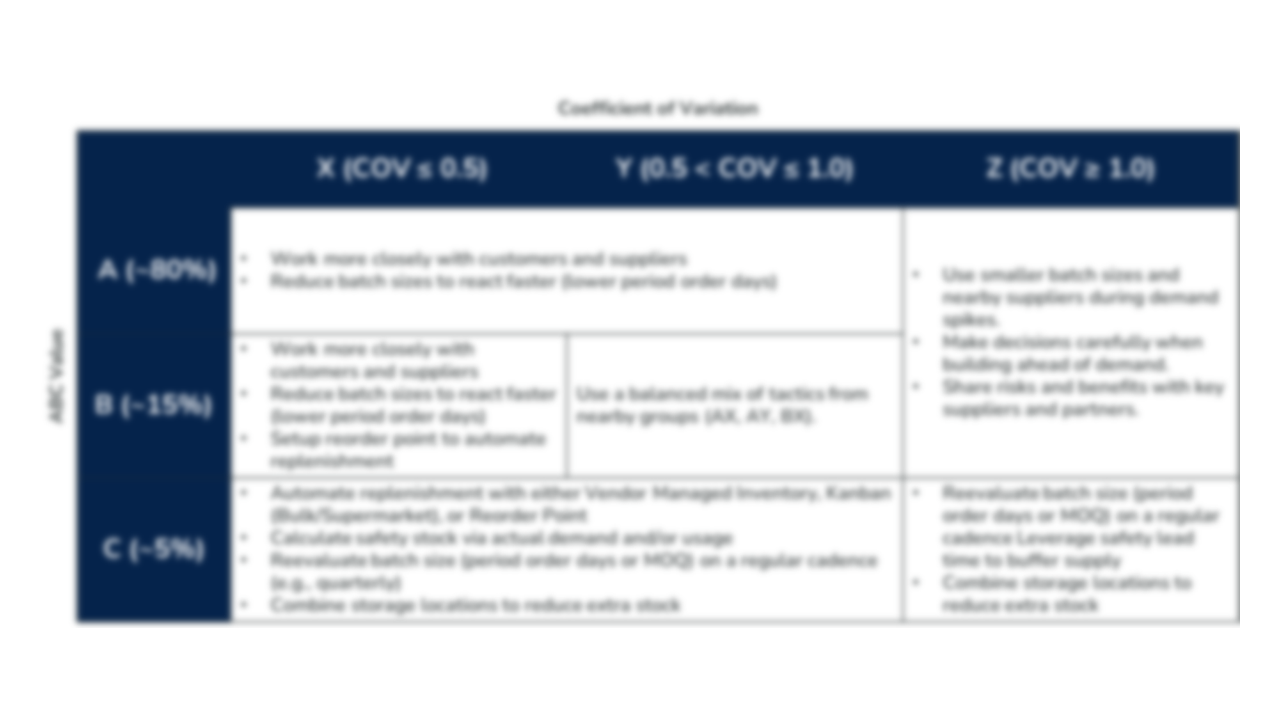
Different parts need different rules. ABC/XYZ tells you which ones matter most.
ABC shows you which parts are most valuable. XYZ shows you how predictable they are.
Together, they give you a simple roadmap:
- High-value, predictable parts need tight schedules and accurate planning parameters.
- High-value, unpredictable parts need smaller batches, better demand management, and closer collaboration.
- Low-value items need simplification, automation, and strict replenishment controls.
This guide shows you exactly what actions to take in each quadrant—so your team can focus effort where it has the biggest impact.
How Every Function Improves Inventory Health
When every team pulls in the same direction, inventory becomes predictable—and easier to control.
Inventory is shaped by decisions made across the entire business, not just Planning or Operations. Each function has clear levers that either add stability or create noise. This guide brings them together:
- Sales
- Engineering
- SIOP/S&OE
- Material Planning
- Sourcing
- Supply Chain
- Operations/Production
- Logistics
When every function makes small improvements, inventory becomes easier to plan, easier to control, and far less expensive to carry. This guide shows each role exactly what to do next.
How Nvexus Helps You Put This Playbook on Autopilot
You get the strategies from the guide. Nvexus helps you execute them automatically.
Nvexus gives your team real visibility into demand, supply, and on-hand inventory—without digging through ERP screens.
1. PO Reschedule
Fix noisy ERP action messages — and give buyers the exact signals they should act on.
Most ERP systems generate hundreds to thousands of reschedule messages every day: pull in, push out, reduce quantity, or cancel.
The problem? They treat every message as equally important, even when most aren’t worth acting on. This leads to buyer overload, early deliveries, excess inventory, and frustrated suppliers.
The Nvexus PO Reschedule Module cleans this up.
It reviews every action message through a rules-based engine that your company controls. Buyers see only the reschedules that matter — based on time windows, part value, spend thresholds, and urgency rules that match your operating rhythm.
The module allows teams to:
- Filter out low-value or low-impact action messages
- Apply different reschedule rules based on how “aggressive” you want to be
- Exclude specific vendors, PO types, commodities, or planners
- Prevent early shipments that inflate inventory
- Ensure supply aligns with real demand, not outdated ERP information
Instead of reacting to noise, buyers know exactly which POs to adjust — giving the entire supply chain a cleaner, more stable flow of material.
2. Excess / Zero-Demand Inventory
See exactly where excess is coming from — and what to do about it across your network.
Most organizations know they have excess inventory, but not why it exists or how to fix it. ERP reports are static, hard to interpret, and don’t show if excess is improving or getting worse.
Nvexus changes that.
The Excess/Zero Demand Module scans your entire database and identifies every part that has:
- Inventory with no demand
- Inventory exceeding demand + safety stock
It then breaks this down by site, part, commodity, planner, and vendor so teams can target root causes instead of guessing.
The module also highlights site-to-site “shopping” opportunities, showing where one site has excess and another has demand. This helps reduce unnecessary purchasing and consume excess stock internally before buying new material.
With trend views, monthly comparisons, and action flags, teams can finally tell:
- Is excess getting better or worse?
- Which planners, suppliers, or parts drive the problem?
- Which excess can be redeployed, sold, or liquidated?
It becomes a clear roadmap for reducing working capital — without hurting service.
3. On-Hand Inventory Segmentation
A clearer picture of what your inventory really is — and what to do about it.
Nvexus uses a proprietary segmentation engine to analyze every SKU’s demand pattern, supply status, and planning parameters. It categorizes your entire on-hand balance into meaningful groups so teams can quickly understand where they are overstocked, where they are at risk, and where improvement opportunities exist.
With one view, you can see what portion of your inventory is:
- Excess / Zero-Demand — Parts with little or no demand where action is needed
- Early-to-Need / Late-to-Need — Material arriving at the wrong time
- Safety Stock — Inventory held for protection, validated against variability
- Work in Progress (WIP) — Material stuck in queues, long cycle steps, or routing delays
Instead of a single number on a balance sheet, segmentation shows the story behind your inventory — and exactly where action should be taken.
4. Inventory Burndown + Audit Trail
See the future of your inventory — and track the past behind every change.
ERP tells you what you have today, but not where your inventory is heading. Nvexus fills that gap with forward-looking Burndown Models for every part.
The model projects future on-hand balances using:
- Current inventory
- Upcoming supply
- Forecasted and actual demand
- Safety stock and parameter rules
This makes it easy to spot shortages early, prevent excess before it compounds, and see when a part’s inventory will stabilize or overflow.
Paired with this is the Inventory Audit Trail, which tracks how demand, supply, and inventory changed over time. It answers questions ERP can’t, such as:
- When did demand spike or drop?
- When did a supplier reschedule or change a quantity?
- Which changes caused inventory to grow or fall?
- Why does today’s plan look different from last month’s?
Together, the Burndown and Audit Trail give your team both the forward view (what will happen) and the backward view (why it happened).
This eliminates guesswork and allows planners to make decisions with confidence.
5. Part-Level Inventory Turns
See which parts drive your performance — and which parts silently drag it down.
Most companies track inventory turns at the site level, but that number hides the real story. High turns on a few fast-moving SKUs can mask thousands of low-turn parts quietly tying up working capital.
Nvexus fixes that by calculating part-level inventory turns for every SKU in your system.
The module shows:
- High-turn items that move quickly and deserve priority
- Low-turn or no-turn items that are tying up cash
- Critical parts where low turns are acceptable to maintain service
With this level of insight, teams can quickly answer questions ERP can’t:
- Which SKUs are overstocked based on their usage?
- Which items need updated lead times, MOQs, or safety stock?
- Where is working capital sitting idle?
- Which planners, suppliers, or product families have the lowest turns?
Part-level turns turn inventory management from guesswork into precise action. Instead of broad cuts, teams can target areas that will actually move the needle.
It gives leaders a simple metric that tells the truth about performance — one SKU at a time.
6. ABC/XYZ Segmentation
Smarter stocking decisions start with smarter classification.
Not all parts behave the same — so they shouldn’t be treated the same. ABC/XYZ segmentation gives your team a clear, structured way to decide how to plan, buy, and stock every SKU.
Nvexus automatically classifies each SKU using:
- ABC — the financial value and business impact of the part
- XYZ — the predictability and variability of demand
Together, these two views create a powerful map of inventory behavior.
For example:
- A/X items are high-value and predictable → require tight control and accurate parameters
- A/Z items are high-value and unpredictable → need better demand reviews and smaller batches
- C items have low value → need simplified policies, automation, and strict replenishment rules
Segmentation becomes the anchor for better planning decisions:
- How much safety stock should we hold?
- Which parts need faster reschedules?
- Which items should be Make-to-Order vs. Make-to-Stock?
- Where do we need supplier flexibility?
- Which parts are candidates for VMI, consignment, or lot size reduction?
ABC/XYZ removes the guesswork by giving every SKU a clear identity — and giving planners a clear path for optimizing it.
When paired with Nvexus’ other tools, segmentation becomes a core part of a smarter, more confident inventory strategy.
FAQs
What is inventory avoidance?
Avoiding inventory means stopping unnecessary supply before it arrives—like canceling POs, enforcing delivery windows, and aligning supply orders to real need dates.
What is inventory reduction?
Reduction focuses on shrinking what’s already on hand through planning improvements, cycle time cuts, excess cleanup, and smarter sourcing.
How does ABC/XYZ help?
It tells you which items matter most (ABC) and how predictable they are (XYZ), so you choose the right tactics for each part.
Why do early deliveries cause problems?
Early shipments inflate on-hand inventory, and increase carrying cost.
Can ERP calculate inventory turns automatically?
Typically not. Site-wide 13pt inventory turns are distorted by manual adjustments. Nvexus calculates turns at the SKU level so you can see which parts move and which don’t.
Want to go deeper? Our Inventory Turns Calculator shows exactly how to calculate site-wide turns and interpret this metric the right way.
What drives excess inventory?
Common causes include wrong parameters, inaccurate demand, early buys, high MOQs, and long lead times.
Why is Material Planning so important?
Planners own the parameters that drive ERP buying. When data is wrong, ERP over-buys or buyers rely on gut feel.
What does Nvexus automate?
Reschedules, excess inventory discovery, segmentation, and SKU-level forecasting—giving teams the clarity ERP alone can’t provide.